Sunday, August 31, 2008

New Advertiser www.HockeyOverstock .com

I would like to welcome our newest affiliate advertiser:
HockeyOverstock.com


From everything I've heard, they offer excellent customer service and very competitive prices. Here's the consumer feedback on PriceGrabber.

If you have any comments on your dealings with Hockey Overstock, please add them to this post. I only allow reputable advertisers on this blog.

I hope you find some great deals!

Thursday, August 28, 2008

Yoga for Hockey Players

Yoga can do wonders for your flexibility.

The incredible stretches and deep breathing increases the blood supply to your muscles and ligaments which reduces the chance of injury.

The problem is that mosts of the guys I know just aren't MAN enough to start chanting a mantra and assume the Lotus position to get their Chakras cleansed.

Yoga a powerful tool for stretching and strengthening the muscles and increasing flexibility. Physically, hockey demands a lot of strength from legs. This mean that hockey players keep a lot of stress in their legs. Calves, quads, gluteus muscles and lower back muscles are heavily used. There are many yoga stretches that can help after hockey play, to relieve tension and prepare for the next game.

A great yoga stretch to increase your flexibility and strength is called The Triangle. Check out Yoga Hockey stretches.

Georges Laraque is just one of a growing number of NHL PROs who practice Yoga as part of their off-ice strength and conditioning . Laraque appears to have found a relaxed state of living and harmony with what he calls “Power Yoga" in 100 degree heat.

From NHL.com:
"The game can be stressful on your body and on you mentally," says Laraque. "You go there and it's just really relaxing. It's really quiet and it's hard to explain but you don't think of any problems or anything else. It's so good and relaxing and purifying.”

“Most guys that fight use the weights, weights, and weights, and they’re so big in their bodies that the muscle doesn’t matter,” Laraque said. “Yoga helps your core strength and that is way better than weights. I’m not the strongest guy weight-wise with enforcers in the NHL, but I’m strong, but not because I bench press six plates. If you do yoga, you don’t need to do weights that much because it’s like a weight exercise, but instead of using weights, you’re using your body.”

Laraque started practicing Yoga with Shawn Horcoff when he was with the Oilers. Chicago's Martin Havlat and Montreal's Mike Komisarek and Christopher Higgins have increased their self-awareness on both a physical and psychological level as well.


The Canucks: Warriors, Cobras, or Downward Facing Dogs?


Wednesday, August 27, 2008

Is Hockey the New Viagra?

Play Hockey to Score both On and Off the Ice

Ice hockey is a great game. It's fun, exiting, challenging, and an awesome workout. It also turns out that playing hockey can energize your sex life as well!

If you're not in the greatest shape, playing hockey will definitely get you there. The pace of the game and the sheer energy needed to skate after the puck gets your heart and lungs working more than just about any other sport. If you can get on the ice at least twice a week for an hour at a time, you'll start noticing more jump in your step in no time at all.

Your enhanced physique will improve your self-esteem, and get a few extra looks for the opposite sex. Being in better shape improves your blood circulation to all areas of your body including your intimate zones making intimate encounters more gratifying.

Hockey is a great anaerobic workout because it alternates intense physical activity with periods of rest. Basically it's a form of interval training. You play hard for somewhere between 45 and 60 seconds, then rest up on the bench until your next shift.

"Men and women who exercise regularly are going to have increased levels of desire," says Cedric Bryant, PhD, chief exercise physiologist for the American Council on Exercise. "They're going to have enhanced confidence, enhanced ability to achieve orgasm, and greater sexual satisfaction."

So the next time you're thinking about reaching for that little blue pill to spice up the bedroom, reach for your hockey stick instead.

Tuesday, August 26, 2008

Up the Boards

Rifling the puck up the boards is a great way to clear the puck from deep in your own end. Especially towards the end of a shift when your line is exhausted needs a line change.

Clearing the puck up the middle, on the other hand, can result in disaster if the other team gets to the puck while it's still inside the blue line. Whenever my brain shuts down and I screw up on this play, this guy on our team always yells “Never up the middle!!” at the top of his lungs. The lecture often continues after my shift if the other teams scores off my brilliant give-away.


Look For Better Options First

While clearing the puck up the boards is usually a safe play, it's not always the best play. Sometimes 2, or even 3 players from each team will bunch up on the same side of the ice. If you've just fought for the puck in your own corner and try to clear the puck through all that traffic, you're very likely to hit a leg or a stick. Then your team is right back to battling for puck possession again.

Instead, why not start skating with the puck behind your own net? If everyone is bunched up your side, there must be lots of room on the other side! When you run into a forechecker, you can then clear the puck up the far boards. With less traffic on the far side, you've got a better chance of clearing your own end.

Sending the puck up the boards can get your team out of trouble, but it's not exactly a stellar break-out play. Usually the other team ends up with the puck in the neutral zone, or you get an icing call. There's also a chance that the opposing defenseman may keep the puck in if you don't get much on it. Be sure to take a look around before you clear it. You may find an open teammate waiting for a pass.

Let's say you just picked up the puck from behind your own yet. If your winger is open on the half boards (where he's supposed to be), there's no sense loading up and whacking the puck past him. The better play is to simply pass him the puck and get a decent break-out started.

The key to knowing what options are available in your own end is to take a look first.
  • Usually you have more time than you think.
  • Don't just blindly fire it up the boards.
  • There may be a far better play waiting for you.

Sunday, August 24, 2008

Beer / Hockey Ratio


While Balance, Agility, Strength, and Speed all play a vital role in playing hockey, the most important factor for your conditioning is your Beer / Hockey Ratio.

During the winter season I usually play twice a week and quaff 3 or 4 beers after each game. Along with the occasional trip to the gym, I still manage to stay in (relatively) decent shape.

Over the summer I play less than once a week and sometimes go 2 or 3 weeks without stepping on the ice. Unfortunately, with all the barbecues and outdoor summer fun in our all-too-short Canadian summers, my beer consumption INCREASES. More Beer and less Hockey results in packing on too many unwanted (and unattractive) extra pounds. My Beer /Hockey Ratio is way out of whack.

Carrying this extra weight around definitely isn't helping my game any, so If I'm going to have any chance of loosing my newly found fat, it looks like I'm going to have to stay on the stair climber a little longer, bike a little farther, and cut back on the brewskies.

Once I'm back into shape, then I can work on my intense bursts of speed, Herculean strength, explosive power, and fierce acceleration. Wish me luck!

Friday, August 22, 2008

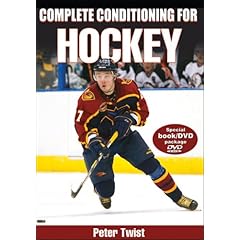
Complete Conditioning for Hockey

Complete Conditioning for Hockey

Excellent 200 page Book with DVD by Peter Twist, former strength and conditioning coach of the Vancouver Canucks.

The original version of this book was published in 1995. The 2007 version comes with a DVD that helps illustrate over 150 on-ice and off-ice hockey-specific training exercises.

Twist's comprehensive training approach is Based on the 5 Pillars of Conditioning:
  • Balance
  • Agility
  • Strength and Power
  • Speed and Quickness
  • Agility
"The Best Athletes are the best hockey players."

Twist provides an effective balance of both the technical theory along with practical explanations in straightforward language.
While aerobic conditioning helps your body recover from fatigue, and gives you the endurance you need for longer shifts, Twist's Hockey-Specific exercises focus on anaerobic conditioning to provide the explosive energy needed to play hockey.
"If all you do to train for Hockey is aerobic conditioning, you're basically training your body to go slow. Racing for the puck is purely anaerobic."

If you incorporate just a fraction of the exercises in this book, you're sure to notice an improvement in your game.

For example, Twist is not a big fan of stretching before a game. Instead he recommends a dynamic warm up. These are exercises like swinging your leg, or rotating your upper body with your stick across your shoulders while skating around the ice.

This type of warm up raises the temperature of your muscles and loosens them up. Your taking a big chance of a tear or a strain by going full-out on your first shift before your muscles are warmed up. Save your stretching for after the game to increase your flexibility and improve your range of motion.

Highly Recommended!

Here's Peter's website: Twist Conditioning

Friday, August 1, 2008

Time to Get Back into Shape!

Here's a couple videos to help get you motivated:


Lots of great training ideas. Just have to get off the couch and go do them!